

Give every bidder the same starting information
A quote is only comparable when it responds to the same job. Send each contractor the same current drawing set, room and finish schedule, structural and services information available, site details, and a written scope. Give the issue date and revision number. If the design is still changing, mark unresolved choices clearly so no one quietly prices a different assumption.
Ask each bidder to state the quote validity period and identify documents used. Confirm whether the price covers labour, materials, transport, unloading, storage, protection, debris removal, testing, coordination and handover. A one-line “complete construction” description leaves too much open to interpretation. Ask for a written response against the same scope table, including “included,” “excluded” or “not yet priced” for each item.
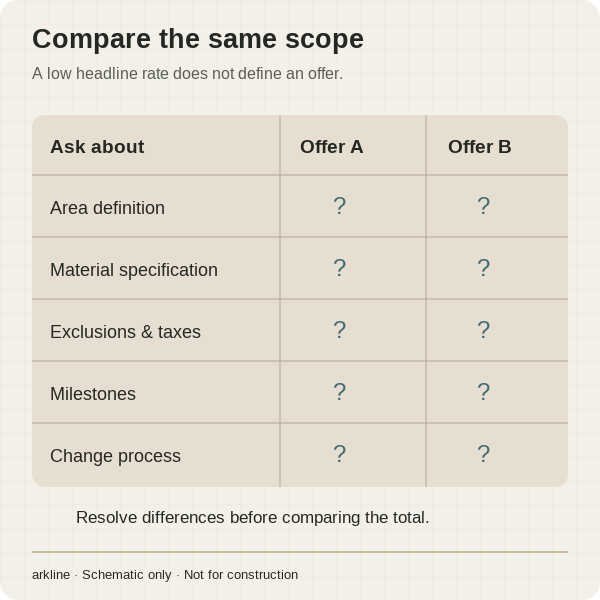
Keep the comparison factual. If one quote includes a specified window system and another says only “windows,” record the difference and request clarification. Do not assume that matching labels mean matching grades, brands, thicknesses or installation methods.
The comparison method and checklist here are editorial guidance. The sources below provide background on building codes and approvals; they do not prescribe commercial quote or contract terms.
Check the area definition and bill of quantities
Ask how the quoted area is measured. “Built-up area,” “carpet area,” “plinth area” and a contractor’s package area may not mean the same thing in two proposals. Request a marked drawing or calculation showing the included floors, covered spaces, staircases, balconies, utility areas and any other components. Confirm which parts are excluded or treated separately. Never multiply an unexplained rate by a floor-area number and assume you have a complete budget.
When a bill of quantities (BOQ) is provided, inspect its units, quantities and descriptions. Check key items against the drawings: excavation, concrete, reinforcement, masonry, plaster, waterproofing, flooring, doors and windows, electrical points, plumbing, painting and external works. Ask who measures completed quantities, who approves substitutions, and how a mismatch is recorded. A BOQ is useful only when both sides understand its basis and the contract says how it will be used.
| Comparison line | Ask for this in writing |
|---|---|
| Area basis | Measurement method, included levels and spaces, drawing reference, exclusions |
| Quantities | BOQ item, unit, estimated quantity, rate and whether quantity is fixed or remeasured |
| Specification | Material description, grade or make where agreed, size, finish and installation scope |
| Services | Electrical and plumbing point counts, fixture allowance, testing and connections |
| External work | Compound wall, gate, paving, drainage, water storage, landscaping and utility connections |
| Commercial terms | Tax treatment, payment milestone, quote validity, schedule and change approval method |
Make exclusions, taxes and allowances visible
Read exclusions as carefully as inclusions. Common areas to clarify include approvals and consultant fees, soil investigation, demolition, dewatering, rock excavation, temporary power and water, utility deposits or connections, compound works, fixtures, appliances, loose furniture, landscaping and post-handover repairs. These are prompts, not a claim that any item is always excluded. Ask each bidder to mark what applies and state who will arrange and pay.
Separate fixed amounts from provisional allowances. For a bathroom fixture allowance, list the amount, what it covers and how a different selection changes the price. Ask whether applicable taxes are included and how they will be handled. Have the contractor or accountant clarify tax treatment for the actual contract; do not infer it from a vague “all inclusive” label.
For example, suppose Quote A is ₹40 lakh and excludes ₹3 lakh of items that Quote B includes in its ₹42 lakh total. A’s adjusted arithmetic is ₹43 lakh versus B’s ₹42 lakh, before other differences. These invented figures demonstrate the method; they are not Bengaluru rates, a recommendation or a cost prediction. Check real quotes against project scope and tax treatment.
Look for gaps such as uncertain quantities, undefined finishes, missing testing or utility work left “by owner.” Ask for a revised comparable quote when a line is ambiguous. Keep revisions so you can see what changed.
Agree how the work and changes will be documented
Ask for a realistic sequence and schedule, not only a single completion date. The plan should identify major stages, owner decisions needed, dependencies such as approvals or utility access, and how progress will be reported. Tie payments to clearly described milestones or measured work, with the evidence for each milestone agreed in the contract. A calendar promise without scope, dependencies and a payment basis is hard to manage.
Before work starts, agree how changes are requested and approved. A useful written change note records the drawing or item affected, reason, added or removed scope, price effect, tax treatment if relevant, schedule impact, and approval from the people authorized to decide. State that work on a change proceeds only after written agreement. Keep a dated log of instructions and updated drawings so site teams do not build from an old version.
Review the final comparison with the same questions for every bidder. Ask who supervises the site, how defects are reported and closed, what handover documents and product warranties are supplied, and whether those commitments are included in the quote or contract. If a commercial or technical term is unclear, get it explained in writing and seek independent professional advice where needed before signing.
Take this to your next meeting
Your site checklist
- Issue the same dated drawings, finish assumptions and scope to each bidder.
- Confirm area definition and have each bidder show its calculation against drawings.
- Compare BOQ units, quantities, specifications, services and external works line by line.
- List exclusions, allowances, owner-supplied items, tax treatment and utility responsibilities.
- Review schedule dependencies, reporting, supervision, payment milestones and handover records.
- Require written, priced and schedule-aware approval of changes before changed work proceeds.
Common questions
Is a quote per square foot enough to compare contractors?
No. A per-area figure is meaningful only when the area is defined and the included scope, specifications, exclusions, taxes and measurement method are clear. Request the underlying calculation and a line-item breakdown.
What should a construction BOQ include?
It should identify the work items, units, quantities and pricing basis, with enough detail to connect them to the current drawings and agreed specifications. Ask how quantities will be measured, approved and adjusted under the contract.
How do I compare a fixed quote with a quote that has allowances?
List each allowance, its amount, what it covers, and the adjustment process if actual selections or quantities differ. Request a common scope and clearly label provisional items before comparing totals.
Reading notes
Sources & further reading
Checked on the dates below. Official requirements and documents can change; confirm the version that applies to your site.
- Bureau of Indian Standards: National Building Code Accessed 10 November 2026
- BBMP Building Plan Approval System overview Accessed 10 November 2026